
No Tax on Tips: The $25,000 Deduction for Beauty Pros (2025–2028)
A new federal tax deduction lets many tipped beauty professionals write off up to $25,000 in tips starting with the 2025 tax year. Hairstylists, nail technicians, estheticians, massage therapists, (and more) all appear by name on the IRS’s list of qualifying occupations.
Did the IRS take way too long to make this change? Yes. Are we going to take full advantage of it with a “better late than never” attitude? Yes. Do I need to restart the wash cycle because I forgot to move clothes to the dryer yet again? Maybe.
Key takeaways
- Beauty professionals who receive tips can deduct up to $25,000 in qualified tips per year on their federal return, for tax years 2025 through 2028.
- The no tax on tips deduction phases out above $150,000 of modified adjusted gross income ($300,000 for joint filers). Married taxpayers must file jointly.
- Tips only count if they’re reported on a form: a W-2 for employees, or a 1099-K for self-employed pros. Unreported tips get no deduction.
- The deduction reduces federal income tax only. Social Security and Medicare taxes on tips don’t change.
OK, back to the serious stuff.
Where this deduction came from
Congress passed the One Big Beautiful Bill Act (OBBBA) in July 2025. It created a new deduction for tip income, running from tax year 2025 through 2028. The IRS calls it the “no tax on tips” deduction. You’ll report it on a new form, Schedule 1-A, attached to your Form 1040.
The no tax on tips deduction lowers your taxable income.
Who qualifies
The IRS built a list of occupations that qualify, sorted into categories. Beauty and wellness workers fall under a category called “Personal appearance and wellness,” which covers:
- Hairdressers, hairstylists, and barbers
- Cosmetologists
- Shampooers
- Skincare specialists, including estheticians, facialists, and electrologists
- Eyelash Technicians
- Massage therapists
- Manicurists and pedicurists
- Many others as well (see link below for full list of occupations)
If your job is on this list and you regularly receive tips, you likely qualify. This holds true whether you’re a W-2 employee at a salon or medspa, or you’re self-employed and renting your own chair or suite.
How much you can deduct, and for how long
The cap is $25,000 in qualified tips per year, for tax years 2025 through 2028. That’s a fixed dollar amount written directly into the law. It stays at $25,000 for all four years; there’s no built-in increase for inflation between now and 2028.
The no tax on tips deduction phases out once your modified adjusted gross income (your income for the year, with a few IRS adjustments) passes $150,000, or $300,000 if you’re married and filing jointly. Those thresholds are fixed too, and they apply the same way in 2025, 2026, 2027, and 2028. Most beauty professionals fall well under that number.
2028 is the last year this deduction exists as of right now. The law ends it for any tax year starting after December 31, 2028, so it won’t be available on your 2029 return unless Congress extends it.
Two rules you must follow:
- Married taxpayers must file a joint return to claim this deduction. Filing separately disqualifies you, even if you’d otherwise qualify.
- You also need a valid Social Security number.
What this looks like in real dollars (is this worth the headache?)
Example 1: The employee stylist. Maya works at a salon and earns $40,000 in wages plus $12,000 in reported tips, all on her W-2. She’s single and takes the standard deduction. Her tip income falls in the 12% federal bracket, so deducting the full $12,000 saves her about $1,440 in federal income tax. That’s money she was paying before 2025 and simply doesn’t pay now.
Example 2: The high-earning booth renter. Danielle rents a suite and clears $110,000 in net profit, including $30,000 in tips that ran through her card processor. The deduction caps at $25,000, so the last $5,000 of tips doesn’t count. Her income puts her in the 22% bracket, so the $25,000 deduction saves her about $5,500 in federal income tax. She still owes self-employment tax on all of it, but that’s a $5,500 swing every year through 2028.
If you’re self-employed or rent a booth
Self-employed stylists, estheticians, and massage therapists can claim this deduction too. However, your tip deduction can’t exceed your net income from that business, before counting this deduction. If your business shows a loss for the year, you can’t use tips to make that loss bigger.
What counts as a qualified tip
The IRS defines a qualified tip as a voluntary cash or charged tip from a customer, including tips split through a pool. The customer has to choose to leave it and choose the amount. A mandatory service charge, like a flat 20% added to a large bridal party’s bill, doesn’t count as a tip under this rule.
The “cash tips” confusion, debunked
The law says only “cash tips” qualify. That phrase has caused a lot of bad information online, so let’s clear it up. The law defines cash tips to include tips paid in physical cash, tips charged to a card, and tips paid through electronic payment apps. If a client tips you through your card reader or a payment app, that’s a “cash tip” under this law.
You may have seen posts claiming only physical cash is deductible. That’s false. Read the definitions in the law and you’ll find the opposite problem: physical cash is the tip most at risk of missing out.
Here’s why. The law only allows the deduction for tips that show up on a form filed with the government. For employees, that’s your W-2. For self-employed pros, that’s a 1099-K from your payment processor, which will break out tips separately going forward. (The updated forms weren’t ready for 2025, so the IRS allowed reasonable estimates for that first year.) Physical cash handed to a self-employed booth renter never touches a payment processor, so it never lands on a 1099-K. No form, no deduction.
If you’re an employee, physical cash still works, as long as you report it to your employer so it gets on your W-2. Which brings us to the next section.
What salon and medspa owners need to know
Owners, this section is for you. The no tax on tips deduction changes some things about how you run payroll, and ignoring it creates real risk.
Your own tips count too. If you’re behind the chair and taking clients, your tips qualify for the deduction the same as anyone else’s.
S-Corp owners: your tips must run through payroll. Many S-Corp owners pay themselves a salary and leave tips out of it. That no longer works. To claim the deduction, your tips need to show up on your W-2, which means adding them to your payroll.
Set up a system for employees to report cash tips. Employees are required to report cash tips to you by the 10th of the month after they receive them. That rule existed long before the OBBBA, but compliance has always been spotty. Now your team has a real reason to report every tip: unreported tips get no deduction. Make it easy for them. A simple monthly form or an entry in your payroll software works.
Know what happens if tips don’t make it onto paychecks. An employee whose tips never hit payroll can still report those tips on their own return using Form 4137. That form names you, the employer. When the IRS sees it, they know you weren’t collecting tip reports the way the law requires, and that’s an audit flag pointed straight at your business. Getting tips onto paychecks protects your team’s deduction and protects you.
For W-2 employees, nothing new is required. Employees have always been required to report their tips and have them run through payroll. When that happens, tips show up on the W-2 automatically, and the deduction takes care of itself at tax time.
There’s a silver lining for owners here too: the same reported tips that get your team their deduction can now earn you a federal tax credit. More on that in our upcoming post on the FICA tip credit for beauty businesses.
What this deduction doesn’t change
This is a federal income tax deduction only. It doesn’t reduce the Social Security and Medicare tax you owe on your tips. If you’re self-employed, you’ll still owe self-employment tax on that income, the tax that covers what an employer would otherwise withhold and match.
Your state return may treat this deduction differently, too. Not every state automatically follows new federal tax rules. We’ll check how your state handles it when we prepare your return if you’re a concierge client.
Already filed your 2025 return?
Check your return to see if you already applied it in Part II, Line 13 (see image):
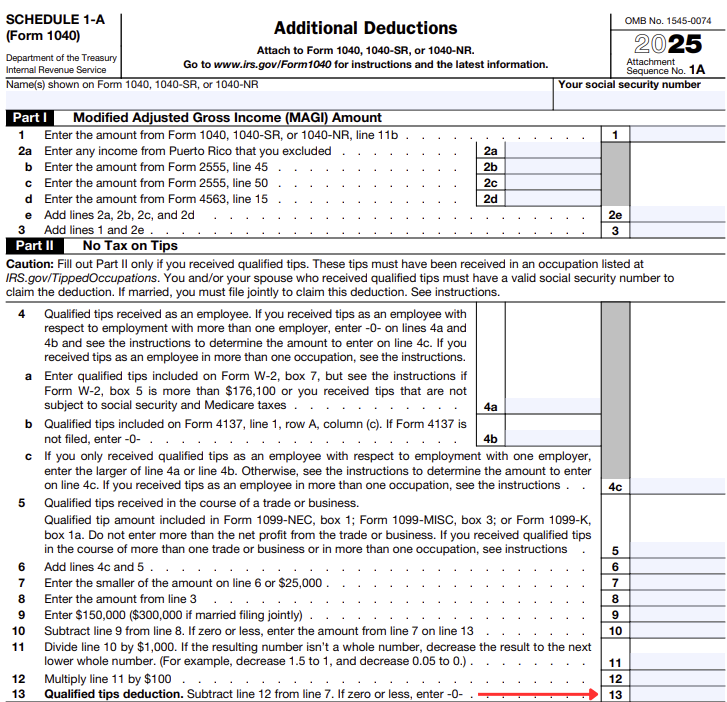
If you filed your 2025 return without claiming the no tax on tips deduction, you can file an amended return on Form 1040-X to claim it now.
FAQ (Frequently Asked Questions)
What to do next
Looking for a CPA who understands the beauty industry like the back of their hands? Click here for our services page.
Sources:
- 26 U.S. Code § 224, Qualified Tips (the statute itself, added by the One Big Beautiful Bill Act, Pub. L. 119-21, July 4, 2025)
- IRS: What the “No Tax on Tips” deduction means for you
- IRS: One, Big, Beautiful Bill: How to take advantage of no tax on tips and overtime
- IRS: Occupations that customarily and regularly received tips on or before Dec. 31, 2024
- IRS: Claiming “no tax on tips” deduction may require an amended return
- IRS Publication 531: Reporting Tip Income (employee reporting deadline, Form 4137)
This post is for general information and isn’t personalized tax advice. Your specific situation may differ. Contact us to talk through how this applies to you.